
Table of content
Estimating global capital from net capital formation (2021-02)
Data source: World Bank.
Update 2024-05-31
Capital is the accumulation of net capital formation [1]Net capital formation (formerly net domestic investment) consists of outlays on additions to the fixed assets of the economy plus net changes in the level of inventories. Fixed assets include land … Continue reading year after year.
Either the formula:
Capital = sum of net capital formation from previous years
But since we cannot go back infinitely to the past, but only up to 1960, due to the availability of data, the formula is:
Capital 2023 = capital 1960 + sum of net capital formation 1960-2022
However, due to the exponential increase in wealth since the end of the Second World War, the accumulation of net capital formation in 1960-2020 is very large compared to capital in 1960, so that the accumulation of net capital formation from a very previous year is a good approximation of current capital, albeit less so. In other words, the accumulation of net capital formation tends towards the actual amount of capital.
Here it is expressed as a percentage of GDP:
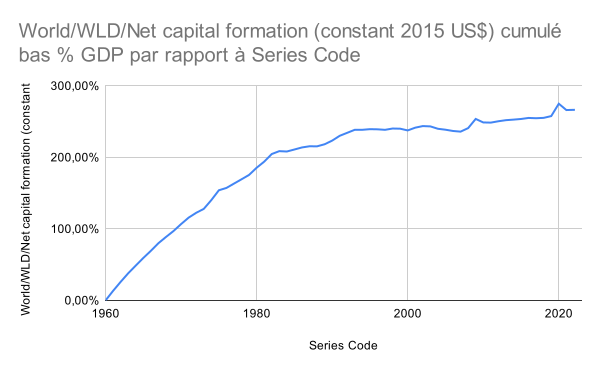
Moreover, capital is never more than an accumulation of crystallized labor from past years, just as GDP is never more than crystallized labor from the present year. For social, technical and industrial reasons, there is, in each period of history, an optimal ratio between the quantity of labor crystallized in the form of capital on the one hand, and the quantity of work which will actually be carried out on this capital on the other hand. So much capital for so much work. Even very different technical levels can have a similar capital / labor ratio – which is usually the case.
In practice, this distribution is not optimum, but it cannot deviate too far from this optimum either. It is not possible, for example, to have 10 times too much capital compared to the quantity of available labor, or vice versa: there would then be too much unused capital, or too much unused labor. The order of magnitude of this ratio must be preserved over very long periods – several decades – although the ratio itself may vary over short periods due to business cycles or other factors.
Thus, the final value on this graph can be taken as a good approximation of the order of magnitude of the capital / labor ratio of previous years. If we carry over this ratio to 1960 to determine the amount of capital for 1960 – since we know the GDP for 1960 – we obtain the following graph:
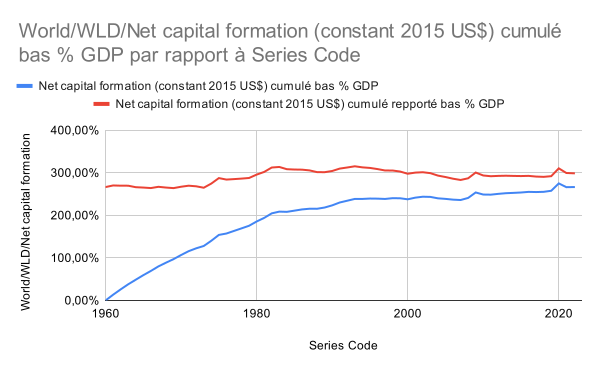
Which does not change much to the capital value of 2022.
The amount of capital seems to tend towards a value close to 300% of GDP.
In order to confirm this hypothesis, we will take a value of 600% of GDP in 1960, then postpone the final value obtained to 1960 and start again.
We see that even if we take a starting value twice as high as its expected value, capital continues to tend towards its optimal value, namely approximately 300% of GDP.
This illustrates the fact that the amount of capital revolves around a relatively constant value over several decades to preserve an optimal ratio between capital and labor.
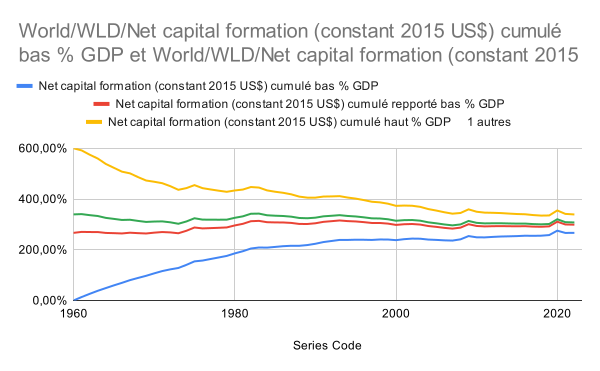
Chart: two reasonable values, and two high and low outliers of the 1960 capital/labor ratio converge to the same result in 2022.
We can deduce from these graphs that the amount of capital is probably 303.29% of GDP, excluding the confidence interval, which would have to be calculated separately.
Estimated global average standard of living
Very simple: divide the total household consumption by the average world population. Or, in 2022:
$PPP88892257364009 / 7950946801 = $PPP11180
Or an average consumption of € 10612 PPP per year and per person in 2022 (price: France).
NB: this is the consumption of merchandises. Non-market goods and services, such as self-produced and self-consumed goods and unpaid domestic work are not counted.
On the other hand, the service rendered by the occupancy of a dwelling by its owner is included and valued as if it were rent, so that an adjustment at this level is not necessary.
The social, technical and industrial reasons which determine the capital/labor ratio (2021-02)
This is an extremely interesting subject.
Suppose the capital/labor ratio is 200%.
Suppose that, for social reasons, capital is used 8 hours a day, by an army of workers working 8 hours a day, but only during the day.
Suppose now that, again for social reasons, the capital is used 16 hours a day, by the same army of workers working 8 hours a day but divided into two shifts: one working day and the other at night.
The capital required to employ the same number of workers is halved.
Capital wears out twice as quickly.
Capital is twice as productive.
In short, the capital/labor ratio falls to 100% for purely social reasons.
–
If the number of working hours per day does not change, the capital/labor ratio may be changed for technological reasons. In one industry, it may be necessary to put 4 units of capital in front of 1 unit of labor, or in another, one for one. This ratio may change due to changes in productivity in the production of capital. If it takes half as much labor to produce the same amount of capital in the face of the same amount of labor, due to the increase in productivity in the production of capital, the value of capital is halved, and the capital/labor ratio, which was for example 2/1, changes to 1/1. Conversely, if it takes twice as much labor to produce more capital in the face of the same amount of labor, due to more advanced technology, the ratio which was for example 2/1 changes to 4/1.
In practice, man increases the productivity in the production of capital at the same time as he introduces new and more advanced technologies, so that the capital/labor ratio remains remarkably stable throughout history.
But we are not immune to major social or technological changes that can significantly alter the capital/labor ratio.
–
The same type of reasoning applies to the production of consumer goods, which determines the value of the labor force, which in turn determines the capital/labor ratio.
Consumer goods function as means of production which participate in the production of a particular capital: variable capital. What I have so far called the capital/labor ratio is nothing more than the ratio of constant capital to variable capital, i.e. the value composition of capital.
The composition of capital is to be understood in a two-fold sense. On the side of value, it is determined by the proportion in which it is divided into constant capital or value of the means of production, and variable capital or value of labour power, the sum total of wages. On the side of material, as it functions in the process of production, all capital is divided into means of production and living labour power. This latter composition is determined by the relation between the mass of the means of production employed, on the one hand, and the mass of labour necessary for their employment on the other. I call the former the value-composition, the latter the technical composition of capital.
Between the two there is a strict [translation!] correlation. To express this, I call the value composition of capital, in so far as it is determined by its technical composition and mirrors the changes of the latter, the organic composition of capital. Wherever I refer to the composition of capital, without further qualification, its organic composition is always understood.
[ADDENDUM: “enge Wechselbeziehung” is translated by “close interrelationship”, not “strict correlation”. Scientifically, there can be no “strict” correlation (see below). Spanish (“estrecha interrelacion”, “close interrelationship”) and French (“lien intime”, “intimate link”) translations are more accurate.]
The value composition of capital can vary according to the productivity in the production of consumer goods or the means of production. With a constant technical composition, if productivity increases faster in the production of consumer goods than in the production of the means of production, then the value of variable capital decreases relative to constant capital, and vice versa.
(ADDENDUM: With a constant productivity, if we modify the technical composition of capital, its value composition varies, i.e. its organic composition varies, since here the value composition varies according to the technical composition)
But since productivity increases at the same time in the production of consumer goods and means of production, in particular because these two sectors often share the same technological level (assembly-line work, energy source, etc.), the value composition of capital has remained relatively constant throughout history.
Socialization of domestic work and domestic property (2021-09-10)
Domestic work constitutes a significant part of human work: it represents around 33% of commercial GDP in France [2]
Domestic work: 60 billion hours in 2010 – Insee Première – 1423 . (2021). Insee.fr. https://www.insee.fr/fr/statistiques/2123967#titre-bloc-13
. Converting part of domestic work to wage labor changes the labor / capital ratio. This is particularly the case for the institutionalized population (retirement homes, hospitals, prisons, etc.)
To the socialization of domestic work corresponds the socialization of domestic property, where consumer goods are rented instead of sold. These consumer goods are then transformed into capital.
We then observe that wage labor or capital can be extended without creation of wealth, by the simple conversion of private production relations into capitalist production relations. This conversion may be accompanied by an increase in productivity, associated with an increase in alienation, as private persons then become doubly dependent on capitalists both as employees and as tenants.
Measurement and crises of Capital (2013-07)

The measure
Even before apprehending the slightest figure, a question arises: how to measure wealth? Two schools then oppose each other: the neoclassical school which sets the usefulness of products as its foundation, and the Marxist school: their value. The usefulness of products is measured in quantity of goods, and their value in quantity of labor. These are two completely different measures. It is remarkable that the bourgeoisie presents wealth as a power over things, while the Marxists present it as a power over men (employing things, employing men). [3]Today, to be completely precise, I would say that wealth derives from the quantity of commodities, while value derives from the quantity of labor. Likewise, although my English is very imperfect, I … Continue reading
Definitions
The bourgeoisie evaluates the quantities of goods in constant price, in purchasing power parity or in international dollars. Constant prices compare quantities of goods in the same country at different times, assuming that the goods each have the same price in a base year. Purchasing power parity makes it possible to compare quantities of goods in several countries but in a single year, assuming that the goods each have the same price as in a benchmark country. The international dollar is a combination of the two: it makes it possible to compare quantities of goods in several countries and at all times, assuming that the goods each have the same price as a reference year in the United States. These units are not perfect, but they do refer to quantities of goods [4]
In general, all prices, including current prices, represent quantities of goods.
.
In accordance with the classics, Marx gives the substance of value: work; its measure: the quantity of work or socially necessary duration of work; its units: the hour, the day, the week of average work. However, these units have mainly a theoretical use because it is not easy to establish a correspondence – even approximate – between an hour of socially necessary work and an hour of real work. Nevertheless, there is a case where an amount of socially necessary labor is exactly equal to the same amount of actual labor: when considering all of the world’s value-producing labor. All the peculiarities of real work – intensity, productivity, skill, etc. – are then melted in totality, i. e. are exactly equal to their respective averages. So, if in the world three billion real workers produced value in a year, that is exactly the same as the value of three billion average workers producing value in a year.
Note on the standard
“What do we care about a unit of value that we cannot multiply or divide without falsifying it?” To that, I will answer first that this is always the case: in one measurement, only the standard is perfectly exact (by definition), the other measurements are approximate; second, that the accuracy of the measurement can be improved by taking into account other parameters of the object being measured – here productivity, intensity, skill, etc. ; thirdly, that a satisfactory precision will be obtained if one considers large quantities suitably chosen; fourth, that important results will be obtained using only the standard without any change.
GDP
Let us return to the world product, that is to say to the world Gross Domestic Product (GDP). As we have seen, its value is exactly equal to the number of workers producing value in a year. We therefore come to the conclusion that GDP, expressed in value, is a function of occupational demography.
This conclusion is of the utmost importance. It means that the GDP grows in proportion to a determined section of the working population, that which produces value [5]All workers do not produce value. For this it is sufficient: that they do not create commodities or services for the market, or else they deal exclusively with the conversion of values in sales … Continue reading. Since surplus value is a fraction of GDP, it is also essentially determined by the growth of that same section. Just like capital, which is made up of accumulated surplus value. In summary, the growth of capital is essentially determined by the growth of the section of the working population which creates value.
Calculation and reserve
We can therefore calculate that if the World GDP of $ 81 trillion PPP (purchasing power parity, price base: USA) was equal to 3.3 billion workers producing value for one year in 2011, then China’s national GDP of the same year, which amounts to 11 trillion PPP dollars, should correspond to 0.45 billion average workers producing value during a year (3.3 billion / 81 * 11 = 0.45 billion). Upon a conversion amount of work it can perform any calculation involving the usual economic variables (GDP, capital, etc.)
Any calculation based on the quantities of goods valued at purchasing power parity laying however the following problem: the price ratio of commodities in a country, in particular the USA, never exactly corresponds to the value ratio of those same commodities, expressed in quantity of labor. This is due to the permanent imbalance of prices in favor of the imperialists, which means that the latter very often sell their goods more expensive (above their value), while the dominated countries sell them much cheaper (below their value). See, for example, agricultural export products on the one hand and high-tech patents on the other (incorporation of over-profit into excessively high prices).
Crises
The crisis of overproduction (industrial crisis)
There is an optimal relationship between the different kinds of industrial capital [6]
Factories, energy (fuels, electricity…) , means of transport, stocks of raw materials or semi-finished products, etc.
and the production of consumer goods. This industrial capital allows the production of another which allows the production of another and so on, up to the production of consumer goods. This ratio is determined by technology. However, industrial capital can only be accumulated in the form of means of production, and not of consumer goods. Therefore, there is a tendency inherent in industrial capitalism to disproportionately increase the share of the means of production over that of consumer goods.
Thus, productive capacities increase, but they are essentially reinjected into the production of industrial capital, which worsens the imbalance until the crisis. The industrial capital market is then saturated, and not all values can flow to the consumer market, which has developed less rapidly. There follows a generalized stampede of money capital [7]
Financial expression of capital (stocks, bonds, derivatives, etc.). Shareholders sell en masse, banks refuse to extend credit, insurance companies increase their premiums, etc.
out of industry, which has the effect of throwing masses of unemployed workers, slowing businesses down or bankrupting them. The consumer market is also developing more slowly, eventually stagnating or even shrinking, which aggravates and prolongs the crisis.
The crisis ends up cleaning the market of the most loss-making companies. As the consumer sector has been relatively less affected by the crisis, the industrial capital market ceases to be congested and a new cycle begins.
Crisis of “overconsumption”
As we have seen previously, consumer goods can function as consumption capital when they are rented or sold on credit. They are therefore subject to vicissitudes similar to industrial capital, especially in the form of credit crashes, when individual borrowers can no longer repay their debts.
Financial crises
It essentially constitutes a correction of the bad valuation of industrial capital or consumer capital. Financial capital is just an appraisal, an abstract valuation of industrial capital or consumer capital.
Economic crises in general
An economic crisis is the sudden correction of an imbalance that has accumulated over time: a poor allocation of resources between different industrial sectors, in particular between the production of constant capital and variable capital, a poor financial assessment of resources. Bad allocation and bad valuation often go hand in hand.
The imperialist crises
See Lenin [8]
Imperialism, supreme stage of capitalism, 1916.
.
No (economic) tendency of the rate of profit to fall according to Book I of the Capital (2021-04)

“The total labour power of society […] is embodied in the sum total of the values”
Marx – the Capital Book I : I.1
“The reproduction of a mass of labour power, which must incessantly re-incorporate itself with capital for that capital’s self-expansion; which cannot get free from capital, and whose enslavement to capital is only concealed by the variety of individual capitalists to whom it sells itself, this reproduction of labour power forms, in fact, an essential of the reproduction of capital itself. Accumulation of capital is, therefore, increase of the proletariat.”
(enphasis added) K. Marx – the Capital Book I: XXV.I
But:
“Now we have seen that it is a law of capitalist production that its development is attended by a relative decrease of variable in relation to constant capital, and consequently to the total capital set in motion. This is just another way of saying that owing to the distinctive methods of production developing in the capitalist system the same number of labourers, i.e., the same quantity of labour-power set in motion by a variable capital of a given value, operate, work up and productively consume in the same time span an ever-increasing quantity of means of labour, machinery and fixed capital of all sorts, raw and auxiliary materials — and consequently a constant capital of an ever-increasing value.”
MIA: K. Marx – the Capital – Book III (13)
Chapter 13 of Book III of Capital contradicts chapters 1 and 25 of Book I of Capital, which define the value on the one hand, and the value composition of Capital on the other hand. The quantitative increase in “means of labour, machinery and fixed capital of all sorts, raw and auxiliary materials”, non-human material resources, has nothing to do with the value of capital, which depends exclusively on the quantity of labor, human resources, which is incorporated therein. A quantitative increase in the material incorporated in capital can be determined by the increase in productivity without an increase in labor, and therefore without an increase in value. As stated in Book I: “Accumulation of capital is, therefore, increase of the proletariat”.
(Addendum 2021-09-08: Reread, one hundred times reread the definitions of the technical, value and organic composition of capital in chapter 25 of book I of Capital, and be careful of the English translation.)
There is therefore no economic tendency of the rate of profit to fall, according to Book I of Capital.
The contradiction between Book I and Book III of Capital is explained by the fact that Books II and III are a compilation of the drafts of Marx by Engels, while Book I is a completed work.
Thus, Book III of Capital employs an older conception of value than Book I. In Book I, capital is measured in quantity of labor, while in Book III, capital is still represented in the form of an accumulation of material things. It goes without saying that these measures are totally different, and cannot be combined in the same calculation as if they had the same unit.
There are, and there will be, however, two distinct declines in the rate of profit of capital, one measured in quantities of labor, the other measured in material quantities, but for reasons different from those described in chapter 13 of book III of the Capital.
There is currently a decline in the rate of profit measured in quantity of work, due to the slowdown in world population growth, and therefore ultimately in the part of the population that creates value.
There will soon be a drop in the rate of profit measured in material quantities, due to the depletion of natural resources and the destruction of the environment by capitalism. This material “rate of profit” could turn negative. The accumulation of material capital could turn negative for other reasons: economic crisis, catastrophic management of an epidemic or world war.
–
The Capital is not a bible. Marxists must not have the fetishism of the tendency of the rate of profit to fall.
Book I is a completed treatise on economics, with precise definitions and a precise use of measure and units. It has been the subject of several revisions and translations carried out and verified by Marx himself, so that the latest editions, particularly German and French, must be considered as the final version of Book I.
Books II and III are drafts compiled with maximum rigor by Engels. They enlighten us on the evolution of Marx’s thought, and inform us about many elements that should have been included in the Capital. But they are incomplete and often contradictory with Book I. When a contradiction is raised, it must be understood and clarified.
All economic reasoning must be tested in the data of econometrics. Speculative reasoning without econometric confrontation is worthless because it is non-materialist.
–
Particular attention must be paid to measurement and units. The measure is the magnitude of a property of an object: for example its length or its mass. A unit is a standard whose multiplication and fraction give the measure, for example the meter or the kilogram.
Some units are concrete, others abstract. The concrete hour of work is, for example, a concrete unit of measurement, but it has the defect of being heterogeneous: an hour of concrete work is never quite identical to another hour of concrete work, and completely different in different economic sectors.
The abstract work year is an abstract unit of measurement, but it is homogeneous: the work year of an abstract worker is always equal to another year of work by an abstract worker. This is a simple average from the total sum of a year of work for all concrete workers.
Be careful, however, to the measurement of value in the quantity of labor, because the quantity of labor necessary for the production of a certain quantity of goods is not the same according to the place and the moment. The working year of an average worker must therefore always be defined according to the place (for example: “World”), and the moment (for example: “2019”).
A predictable war (2013-11)

This is a brief introduction to the economic theories that can be deduced from the evolution of oil resources in the world. These theories have not been developed by economists, but by geologists and engineers specialized in oil extraction. The main thrust of their theories is that the entire economy is based on the primary sector (water, energy, building materials…) and therefore the primary sector drives the economy, and therefore history, in the long run. These theories offer an interesting point of view to explain wars, recessions and economic developments. Since they are materialist, they can be integrated into the materialist conception of history.
According to these geologists, we have experienced a first cycle of extraction starting at the beginning of the industrial revolution and ending during the first two world wars: this is the coal cycle. From 1800 to 1913, coal production grew by an average of 4.3% per year, apparently steadily [9]
Calculate from Table 1 of “World Commercial Energy Production”, Bouda Etemad, p. 6: (1235.7/10.6)^(1/113)-1= 4.3%.
. During the 19th century, coal gradually replaced almost all other primary energy sources: in 1913, it represented 92.6% of the market [10]
ibid.
. Then from 1913 to 1950, it is stagnation: 0.4% annual growth on average only [11]
ibid. (1445,0/1235,7)^(1/37)-1= 0,4%
. Oil then takes over.
The industrial production of oil begins in the second half of the 19th century at a steady growth rate: from 1890 to 1970, 7% on average [12]
ibid. (3309,4/14,3)^(1/80)-1=7%
. In 1950, oil already accounted for 30.3% of commercial primary energy (coal: 37.9%), and in 1970, 47.7% (coal: 31.3%). But by 1971 [13]
ASPO newsletter #23, p. 6.
the United States reached its peak oil (the point at which the level of extraction reaches its maximum and inexorably declines), and in 1987 [14]
ASPO newsletter #31, p. 9.
, it was the turn of the USSR. From 1970 to 1990, oil production nevertheless continued to grow, very irregularly, at an average rate of 1.6% per year [15]
“World commercial energy production”, ibid. (4551.5/3309.4)^(1/20)-1=1.6%
. Today the ASPO [16]
Association for the Study of Peak Oil and Gas.
predicts the peak of world production before 2020 [17]
ASPO, Jean Laherrere, Oil and Gas Forecasts 1900-2100, p. 16.
, followed by gas around 2030 [18]
ibid., p. 6.
.
The end of the coal cycle was marked by two world wars and the physical destruction of industry in the advanced countries (except for the United States). Why was the transition not peaceful?
In 1913, almost all industry was based on coal. Great Britain, which alone accounted for 38% of European coal production [19]
World Energy Production: 1800-1985, Bouta Etema & Jean Luciani, p. 189 : 249279,0/653918,3=38%
, dominated France [20]Alain Beltran French coal from 1914 to 1946, a limited modernization: “Until 1900, imports accounted for 33% of consumption, but the economic growth of the Belle Epoque, which was faster than … Continue reading and Italy [21]
It seems that there was no coal in Italy. Coal production: in 1914, not even 0.3% of that of Great Britain.
by its exports. Yet in 1913, Britain reached its coal peak, while Germany’s production continued to grow [22]
http://www.institut-strategie.fr/IHCC_14.htm incomplete source. By 1914, Germany was producing almost as much as Britain.
. In an imperialist economy, England is thus constrained to break Germany’s momentum, while Germany must instead break England’s monopoly. Imperialist rivalries in the processing and consumption sectors depend on primary rivalries in the extraction sector.
For example, Germany took Italy into its fold as soon as its coal became cheaper than Britain’s (Rome-Berlin axis) [23]
ASPO newsletter #73, art. 787, p. 5.
. The sabotage of the northern mines during the Great War proceeded from the same logic: to make France dependent on German coal in the long term [24]
French coal from 1914 to 1946, a limited modernization p. 3
.
For their part, the United States, endowed with significant oil reserves, had plenty of time to make their energy transition without risking an invasion of their territory (favorable geographic position). It should also be noted that the coal power of the United States was also enormous: 1st exporter, 1st world producer [25]
http://www.persee.fr/web/revues/home/prescript/article/ingeo_0020-0093_1936_num_1_6_6571 .
.
The domination of Europe by the most powerful imperialist became all the more urgent as the United States completed its energy transition. It was also necessary to conquer new oil resources outside Europe (North Sea oil was not discovered until 1958). This explains both the alliance and then the war of Germany against the USSR and the peace proposals of Germany to Great Britain as soon as France was invaded (Germany had proposed not to touch the British empire if it did not prevent it from carving out colonies in the former French empire and the USSR).
We must analyze the current wars in the Middle East as preparatory wars for the next energy transition. An energy transition takes place in two phases: first, the observation of a shortage of strategic raw materials, which cannot be replaced immediately. This shortage provokes wars for the reconquest of the zones where these raw materials are extracted, in order to limit, for its own imperialism and at the expense of others, its own decline. These wars are the equivalent of the First World War.
The second phase appears only after the partial development of new technologies, based on new raw materials. The imperialists realize that the raw materials they need are to be found in territories they do not dominate: the “division of the world” no longer corresponds to their strategic interests. These wars are of the same type as the Second World War.
If the revolution does not sweep away imperialism during the next energy transition, then there will be several wars of a magnitude that can only be compared to the First and Second World Wars.
References
| ↑1 |
Net capital formation (formerly net domestic investment) consists of outlays on additions to the fixed assets of the economy plus net changes in the level of inventories. Fixed assets include land improvements (fences, ditches, drains, and so on); plant, machinery, and equipment purchases; and the construction of roads, railways, and the like, including schools, offices, hospitals, private residential dwellings, and commercial and industrial buildings (Gross capital formation), minus the consumption of fixed capital (wear and tear, obsolescence, destruction). Inventories are stocks of goods held by firms to meet temporary or unexpected fluctuations in production or sales, and “work in progress.” According to the 1993 SNA, net acquisitions of valuables are also considered capital formation. Definition adapted from that of gross capital formation by the World Bank (NE.GDI.TOTL.CD). |
|---|---|
| ↑2 |
Domestic work: 60 billion hours in 2010 – Insee Première – 1423 . (2021). Insee.fr. https://www.insee.fr/fr/statistiques/2123967#titre-bloc-13 |
| ↑3 |
Today, to be completely precise, I would say that wealth derives from the quantity of commodities, while value derives from the quantity of labor. Likewise, although my English is very imperfect, I would say “work” refers to concrete labor (material power), which manifests itself in the production of goods or services, while “labor” refers to abstract labor, which manifests in value creation (social power). Finally, I would say today “to use things” and “to employ people”. These definitions could evolve across the history, outside the market economy. |
| ↑4 |
In general, all prices, including current prices, represent quantities of goods. |
| ↑5 |
All workers do not produce value. For this it is sufficient: that they do not create commodities or services for the market, or else they deal exclusively with the conversion of values in sales or finance. ADDENDUM 2022-10-10. Source: Book II of Capital. However, the exclusion of the labor of commodity conversion in the formation of value in Book II of Capital is perhaps abusive, insofar as conversion is the form of distribution in the commodity economy, and that distribution is necessary in any society. Thus, the labor of conversion should probably be included in the formation of value, insofar as it is socially necessary for distribution. In communist society, distribution is effected by means of planning, not conversion. Creating value does not necessarily mean doing useful work, and conversely not creating value is not synonymous with uselessness. |
| ↑6 |
Factories, energy (fuels, electricity…) , means of transport, stocks of raw materials or semi-finished products, etc. |
| ↑7 |
Financial expression of capital (stocks, bonds, derivatives, etc.). Shareholders sell en masse, banks refuse to extend credit, insurance companies increase their premiums, etc. |
| ↑8 | |
| ↑9 |
Calculate from Table 1 of “World Commercial Energy Production”, Bouda Etemad, p. 6: (1235.7/10.6)^(1/113)-1= 4.3%. |
| ↑10 |
ibid. |
| ↑11 |
ibid. (1445,0/1235,7)^(1/37)-1= 0,4% |
| ↑12 |
ibid. (3309,4/14,3)^(1/80)-1=7% |
| ↑13 |
ASPO newsletter #23, p. 6. |
| ↑14 |
ASPO newsletter #31, p. 9. |
| ↑15 |
“World commercial energy production”, ibid. (4551.5/3309.4)^(1/20)-1=1.6% |
| ↑16 |
Association for the Study of Peak Oil and Gas. |
| ↑17 |
ASPO, Jean Laherrere, Oil and Gas Forecasts 1900-2100, p. 16. |
| ↑18 |
ibid., p. 6. |
| ↑19 |
World Energy Production: 1800-1985, Bouta Etema & Jean Luciani, p. 189 : 249279,0/653918,3=38% |
| ↑20 |
Alain Beltran French coal from 1914 to 1946, a limited modernization: “Until 1900, imports accounted for 33% of consumption, but the economic growth of the Belle Epoque, which was faster than that of hexagonal extraction, raised the share of imports to 40% in 1913. Great Britain provided the majority (60%) of imported coal. The war keeps this proportion very high etc.” p. 2. |
| ↑21 |
It seems that there was no coal in Italy. Coal production: in 1914, not even 0.3% of that of Great Britain. |
| ↑22 |
http://www.institut-strategie.fr/IHCC_14.htm incomplete source. By 1914, Germany was producing almost as much as Britain. |
| ↑23 |
ASPO newsletter #73, art. 787, p. 5. |
| ↑24 | |
| ↑25 |
http://www.persee.fr/web/revues/home/prescript/article/ingeo_0020-0093_1936_num_1_6_6571 . |