
Data source: World Bank.
Update 2024-05-31
Capital is the accumulation of net capital formation [1]Net capital formation (formerly net domestic investment) consists of outlays on additions to the fixed assets of the economy plus net changes in the level of inventories. Fixed assets include land … Continue reading year after year.
Either the formula:
Capital = sum of net capital formation from previous years
But since we cannot go back infinitely to the past, but only up to 1960, due to the availability of data, the formula is:
Capital 2023 = capital 1960 + sum of net capital formation 1960-2022
However, due to the exponential increase in wealth since the end of the Second World War, the accumulation of net capital formation in 1960-2020 is very large compared to capital in 1960, so that the accumulation of net capital formation from a very previous year is a good approximation of current capital, albeit less so. In other words, the accumulation of net capital formation tends towards the actual amount of capital.
Here it is expressed as a percentage of GDP:
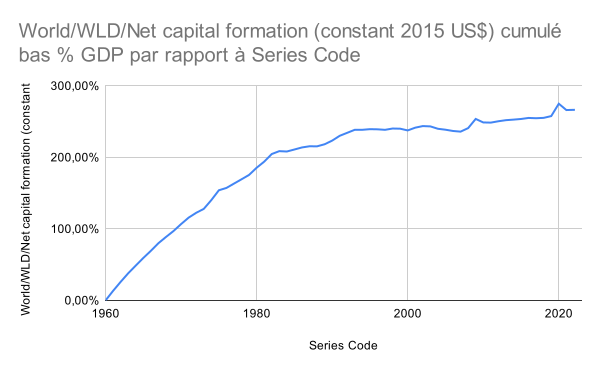
Moreover, capital is never more than an accumulation of crystallized labor from past years, just as GDP is never more than crystallized labor from the present year. For social, technical and industrial reasons, there is, in each period of history, an optimal ratio between the quantity of labor crystallized in the form of capital on the one hand, and the quantity of work which will actually be carried out on this capital on the other hand. So much capital for so much work. Even very different technical levels can have a similar capital / labor ratio – which is usually the case.
In practice, this distribution is not optimum, but it cannot deviate too far from this optimum either. It is not possible, for example, to have 10 times too much capital compared to the quantity of available labor, or vice versa: there would then be too much unused capital, or too much unused labor. The order of magnitude of this ratio must be preserved over very long periods – several decades – although the ratio itself may vary over short periods due to business cycles or other factors.
Thus, the final value on this graph can be taken as a good approximation of the order of magnitude of the capital / labor ratio of previous years. If we carry over this ratio to 1960 to determine the amount of capital for 1960 – since we know the GDP for 1960 – we obtain the following graph:
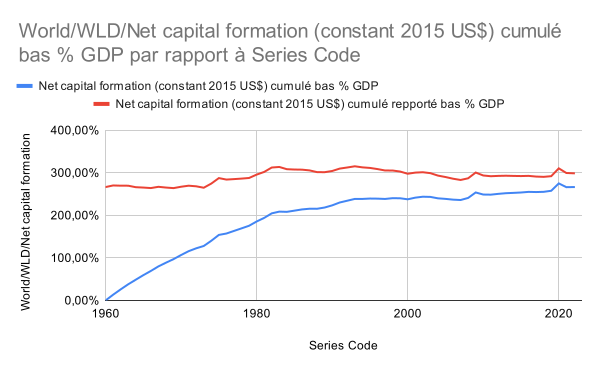
Which does not change much to the capital value of 2022.
The amount of capital seems to tend towards a value close to 300% of GDP.
In order to confirm this hypothesis, we will take a value of 600% of GDP in 1960, then postpone the final value obtained to 1960 and start again.
We see that even if we take a starting value twice as high as its expected value, capital continues to tend towards its optimal value, namely approximately 300% of GDP.
This illustrates the fact that the amount of capital revolves around a relatively constant value over several decades to preserve an optimal ratio between capital and labor.
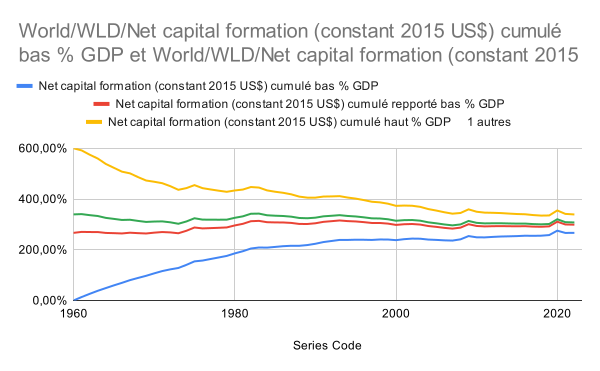
Chart: two reasonable values, and two high and low outliers of the 1960 capital/labor ratio converge to the same result in 2022.
We can deduce from these graphs that the amount of capital is probably 303.29% of GDP, excluding the confidence interval, which would have to be calculated separately.
References
| ↑1 |
Net capital formation (formerly net domestic investment) consists of outlays on additions to the fixed assets of the economy plus net changes in the level of inventories. Fixed assets include land improvements (fences, ditches, drains, and so on); plant, machinery, and equipment purchases; and the construction of roads, railways, and the like, including schools, offices, hospitals, private residential dwellings, and commercial and industrial buildings (Gross capital formation), minus the consumption of fixed capital (wear and tear, obsolescence, destruction). Inventories are stocks of goods held by firms to meet temporary or unexpected fluctuations in production or sales, and “work in progress.” According to the 1993 SNA, net acquisitions of valuables are also considered capital formation. Definition adapted from that of gross capital formation by the World Bank (NE.GDI.TOTL.CD). |
|---|
1 thought on “Estimating global capital from net capital formation (2021-02)”