
Interview with Sylvain Rousselot, psychotherapist, who asked Inserm (National Institute of Health and Medical Research) for the scientific correspondence of one of its agents, Dominique Costagliola, with a British researcher, Andrew Hill. Both have been working on a covid-19 drug candidate, ivermectin, a cheap drug that has fallen into the public domain. Andrew Hill published an incriminating report in opposition to ivermectin, completely changing his opinion which had previously been very favorable to this drug. He is mandated by the WHO as an expert, and the WHO took his report into account when drafting its recommendation against ivermectin. But Andrew Hill admitted, in a telephone recording that is now public, that the conclusions of his report had been influenced by his sponsor: Unitaid. Unitaid is a drug purchasing group, very close to the pharmaceutical industry1. Shortly before the report was published, Unitaid offered a $40 million grant to Andrew Hill’s employer, the University of Liverpool. These two events could be linked…
The scientific correspondence of Dominique Costagliola and Andrew Hill could shed new light on the links of interest and influence between different actors during the evaluation of a drug, and on the way which the WHO constructs its recommendations. However, Inserm refused the communication of this correspondence. However, this document relates to the evaluation of a drug and is a contribution to scientific expertise, which corresponds exactly to Inserm’s public service mission. Mr. Rousselot brought the case before the Paris administrative court, which replied that due to the special status of civil servant-researchers, the scientific correspondence of Inserm agents could be detached from their public service mission, and therefore that Inserm was authorized not to communicate it to the citizen.
What does the correspondence of Dominique Costagliola and Andrew Hill contain? Why did Andrew Hill change his mind about ivermectin?
The case will soon be brought before the Council of State…
What is the evidence and testimony implicating Andrew Hill, Andrew Owen, Unitaid and the University of Liverpool?
March 17, 2021, I discovered with many others the interview of Doctor Tess Lawrie, in which she declared that she has had a Zoom meeting with Andrew Hill, a WHO expert in charge of the evaluation of ivermectin in the treatment of covid-19. During this exchange, he said that the conclusions of his article had been influenced by his sponsor, Unitaid. Also mentioned was the name of Dominique Costagliola, director of research at Inserm who had participated, to an unknown degree, in the elaboration of the article, although she is not cited as author2.
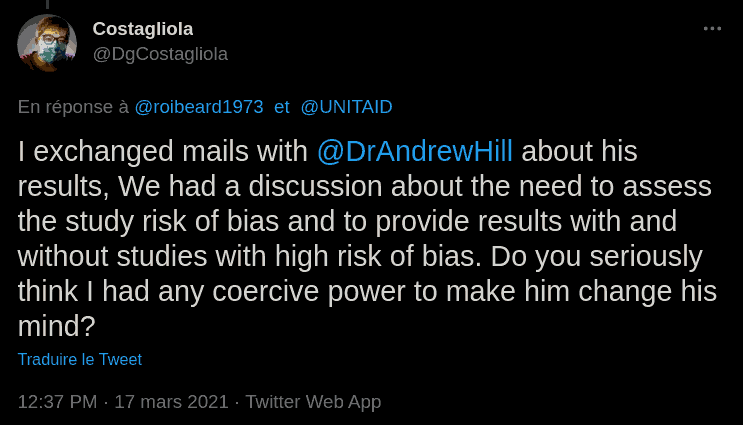
The same day, Dominique Costagliola publicly acknowledged having had a correspondence with Andrew Hill, concerning the exclusion criteria for the meta-analysis. She defended herself, however, for having had the slightest power of coercion over Andrew Hill, to explain his unexpected reversal on ivermectin3 .
On March 7, 2022, documentarian Phil Harper noticed a name in the metadata of the study’s preprint pdf: Andrew Owen4. Andrew Owen is a colleague from the same university as Andrew Hill5, but is not cited as author. However, it was on his computer that the pdf of the preprint was exported, as anyone can verify: go to the web page of the preprint6, download the pdf (top right, “Download PDF”), then, after opening it, menu → document properties.
On January 12, 2021, Andrew Owen’s varsity team received a $40 million grant from Unitaid7, also funder of Andrew Hill’s study, the preprint of which will be published on January 19, 2021.
Thus, we have every reason to believe Dominique Costagliola when she writes that she did not use coercion to get Hill to change his conclusions. It is quite possible that there was a high level meeting in Liverpool or on the internet, between Andrew Hill, Andrew Owen, Unitaid and some senior university officials, in order not to let escape the grant of 40 million dollars from Unitaid, and that Unitaid gets the desired conclusions in Andrew Hill’s article. Andrew Owen, grant recipient through his CELT project, would be responsible for editing the article, as illustrated by the metadata of the pdf generated on his computer. This is a hypothesis that naturally follows from elements known to the public.
On November 16, 2021, the transcript of excerpts from the Zoom conversation between Andrew Hill and Tess Lawrie8 was released. A few days later, videos of these snippets themselves were published9, establishing beyond any doubt that the testimony of Dr. Tess Lawrie and the transcription of Robert F. Kennedy were accurate:
Lawrie then asks again: Would you tell me? I would like to know who pays you as a consultant through WHO?
Hill: It’s Unitaid.
Lawrie: All right. So who helped to … Whose conclusions are those on the review that you’ve done? Who is not listed as an author? Who’s actually contributed?
Hill: Well, I mean, I don’t really want to get into, I mean, it … Unitaid …
Lawrie: I think that . . . it needs to be clear. I would like to know who, who are these other voices that are in your paper that are not acknowledged? Does Unitaid have a say? Do they influence what you write?
Hill: Unitaid has a say in the conclusions of the paper. Yeah.
Lawrie: Okay. So, who is it in Unitaid, then? Who is giving you opinions on your evidence?
Hill: Well, it’s just the people there. I don’t …
Lawrie: So they have a say in your conclusions.
Hill: Yeah.
If the facts are true, this could constitute an offense of influence peddling, punishable by 5 to 10 years in prison and a million euro fine, according to articles 433-110 and 433-211 of the Penal Code.
According to these sections of law, it is not necessary that Andrew Hill himself benefited from the grant granted by Unitaid to his university. It suffices that he has modified his conclusions, or caused his conclusions to be modified, so that someone else benefits from these advantages, for example his employer. It is also not necessary that the grant was paid to the university before or after the publication of the preprint: the moment of the payment is irrelevant.
Taking into account the elements quoted above, and freely accessible by all, we believe that there is sufficient evidence and corroborating testimony to launch an arrest warrant against Andrew Hill, against Andrew Owen and against other officials of the University of Liverpool and Unitaid, on influence peddling charge. Andrew Hill, along with some of his colleagues and funders, must be questioned by the police to explain themselves: on the testimony of doctor Tess Lawrie, on the recording of their Zoom meeting, on the metadata of the preprint article implicating Andrew Owen, and on the grant that Unitaid gave to the University of Liverpool for a project led by Andrew Owen himself.
It should be noted that while we believe that these elements are necessary and sufficient to charge Andrew Hill and others people and to issue a warrant for their arrest, we do not pronounce on their possible guilt, which will have to be determined by a court. Whatever our conviction on the subject, the presumption of innocence prevails.
What would be the Inserm’s implication?
What role did Inserm play in all of this? It is still unclear. We know that Dominique Costagliola is connected to the elaboration of the article through her correspondence with Andrew Hill, whom she has openly admitted to having. However, we do not know if this link is innocent or guilty.
But, since Dominique Costagliola is a civil servant-researcher, and she defends that her correspondence with Andrew Hill was of a purely scientific nature, we should have access to this correspondence, through the law on access to administrative documents12. This is the procedure that I launched on March 25, 2021, the judicial side of which at first instance ended on May 4, 2022.
After remaining silent, Inserm broke away from Dominique Costagliola’s correspondence, stating that it was private.
But it is quite simply impossible because on the one hand, in accordance with decree n°83-975 of November 10, 1983 relating to the organization and functioning of Inserm:
The National Institute of Health and medical research has the following missions: […] f) To carry out or contribute to the carrying out of scientific expert opinions.
A correspondence relating to “the need to assess the study risk of bias and to provide results with and without studies at high risk of bias”13 is certainly a matter of scientific expertise, which is part of Inserm’s mission. Risk of bias analysis was used by the WHO in their evaluation of ivermectin14, but not in the evaluation of other drugs, which proves the influence of Dominique Costagliola in the development of WHO recommendations for the treatment of covid-19.
On the other hand, in accordance with Article L121-3 of the General Civil Service Code:
A public official devotes his entire professional activity to the tasks entrusted to him.
Dominique Costagliola does not may carry out what constitutes her public service mission within Inserm, outside Inserm. Any contribution to scientific expertise carried out by Dominique Costagliola is in essence a contribution from Inserm.
The same is true for Andrew Hill who exchanged this correspondence not in a private capacity, but as a Senior Fellow of the University of Liverpool, within the framework of his mission of expertise for the WHO.
From a legal point of view, this correspondence is therefore a correspondence between Inserm and the University of Liverpool, of which Dominique Costagliola and Andrew Hill are only the agents.
As for the independence and freedom of expression of researchers mentioned by the court to assert the non-communication of correspondence to citizens, they simply have nothing to do. As I wrote in my dissertation:
In no case does the law oppose the autonomy of researchers to the dissemination of scientific knowledge, since on the contrary freedom and independence are the means, while free circulation of ideas is the goal. Neither is the autonomy of researchers opposed to the evaluation of their work by the administration, by the researchers themselves or by the citizens interested in the research.
By making the independence of researchers a sacred principle that opposes the circulation of ideas and the evaluation of their work, the administration reverses the means and the goal, puts the law in contradiction with itself and sows the trouble between the state and the public.
Freedom of expression for researchers is a right accompanied by a duty to communicate. Their autonomy is a right accompanied by a duty of evaluation.
No law provides that the scientific work of civil servants-researchers escapes the supervision of the administration, and therefore cannot be accessible to citizens.
It is therefore wrong that the administrative court rejected my request under the pretext of researchers’ freedom of expression. The law does not allow this.
What will be the legal consequences?
We are going to seize the Council of State.
This correspondence potentially relates to an international corruption case, which we are investigating as journalists and citizens in search of the truth.
The pretext, seized by the administrative court, to detach a professional correspondence from the public service mission of an agent, shocks us.
We have the right to information. We have the right to receive documents produced or received by persons within the framework of their public service mission, as long as these are not covered by a secret protected by law. This right is part of the freedom of the press, which all truly democratic states adhere to. If the courts trample it, we will continue to defend it. We will denounce all those who flatter it in public, but despise it in private, acknowledging legitimacy only to the press sponsored by state and financial moguls.
We will continue to request and seek documents held by the authorities, in order to expose them to the public. We will denounce all attempts to conceal public documents, on the pretext that a research official would somehow be entitled to “own scientific freedom, independently of her missions within Inserm” 15, while this civil servant is paid by taxes and carries out her work within Inserm with the means of Inserm, while she corresponded with a foreign agent who admitted in a recorded and published conversation that his expertise with the WHO had been influenced by his sponsor.
We will defend our right to freedom to be informed, freedom of the press and freedom to communicate this information to the public.
Everyone has the right to freedom of expression. This right shall include freedom to hold opinions and to receive and impart information and ideas without interference by public authority and regardless of frontiers.
European Convention on Human Rights, Article 10.
Appendices
Legal resources
Rousselot S. (2021). Request and memorandum — for access to Dominique Costagliola’s correspondence with Andrew Hill, on the evaluation of ivermectin in the treatment of covid-19. Sent to the Administrative Court of Paris in the context of the Rousselot v Inserm case.
Rousselot c Inserm, 2022 TA Paris 2115085/5-2. The decision of the administrative court.
Rousselot S. (2022). Appeal against BAJ decision no. 2609/2022, refusing the award of legal aid. Sent to the Council of State in anticipation of the appeal.
Educational, legal and administrative resources
Tutorial explaining how to request an administrative document
Law no. 78-753 of July 17, 1978, formalized in the Book III: ACCESS TO ADMINISTRATIVE DOCUMENTS AND THE REUSE OF PUBLIC INFORMATION (Articles L300-1 to L351-1) of the Code of relations between the public and the administration.
Website of the Commission for Access to Administrative Documents (Cada).